
Murphy Constructions, a Sunshine Coast commercial concreting and construction company, got a batch of labourer applicants in four days at A$1.50 each, and 94% of the people who applied were local. It came from Meta instant-form hiring campaigns with one role per ad, a short screening form and fast follow-up. This guide covers each part, and the rules Meta applies to job ads.
We run hiring campaigns for builders and trades as part of our construction practice. Murphy's is the one with receipts, so it's the one I'll walk through. The full story, website included, is in the Murphy Constructions case study.
Why do job boards miss most tradies?
Because the good ones already have a job. A concreter with years on the tools isn't refreshing a job board at lunch. They're on Facebook and Instagram at smoko like everyone else.
Meta ads reach those people where they already spend time. The ad has one job: make a good worker stop scrolling and think "that could be me". The form has another: make applying quicker than finishing a pie.
That's the approach. The detail is what makes it work, so here's the detail.
What the campaign delivered
Results
88
Labourer applicants (form)
Four days, Jul 2026. Receipt-backed Meta form results.
Cost per result
A$1.50
Per applicant
Same batch. Spend divided by applicants.
Local
94%
Applicants in the catchment
Same batch. From the location answers.
Case study results. Outcomes vary.
Across the whole campaign, Ads Manager shows 1,105 job applications at A$2.31 each over its lifetime to August 2026. Those are form submissions rather than unique people, so one tradie applying for two roles counts twice. As at September 2026, Murphy had made 7 successful hires from it.
Case study result. Outcomes vary.
What the ad looked like
Nothing clever. The ad says who's hiring, for what, and where the work is. What makes a hiring ad work in a feed:
- One role per ad. A labourer ad and a concreter ad speak to different people. Mix them and both get weaker, and you can't see which role is costing what.
- The region up front. Tradies want to know the travel before anything else. Naming the area also turns away people who'd never make the drive, which helps keep applicants local.
- Plain words about the work: the kind of projects, the crew, when it starts. A photo of a real site or a real crew helps when you have one.
- An easy ask. Tap, answer a few questions, done.
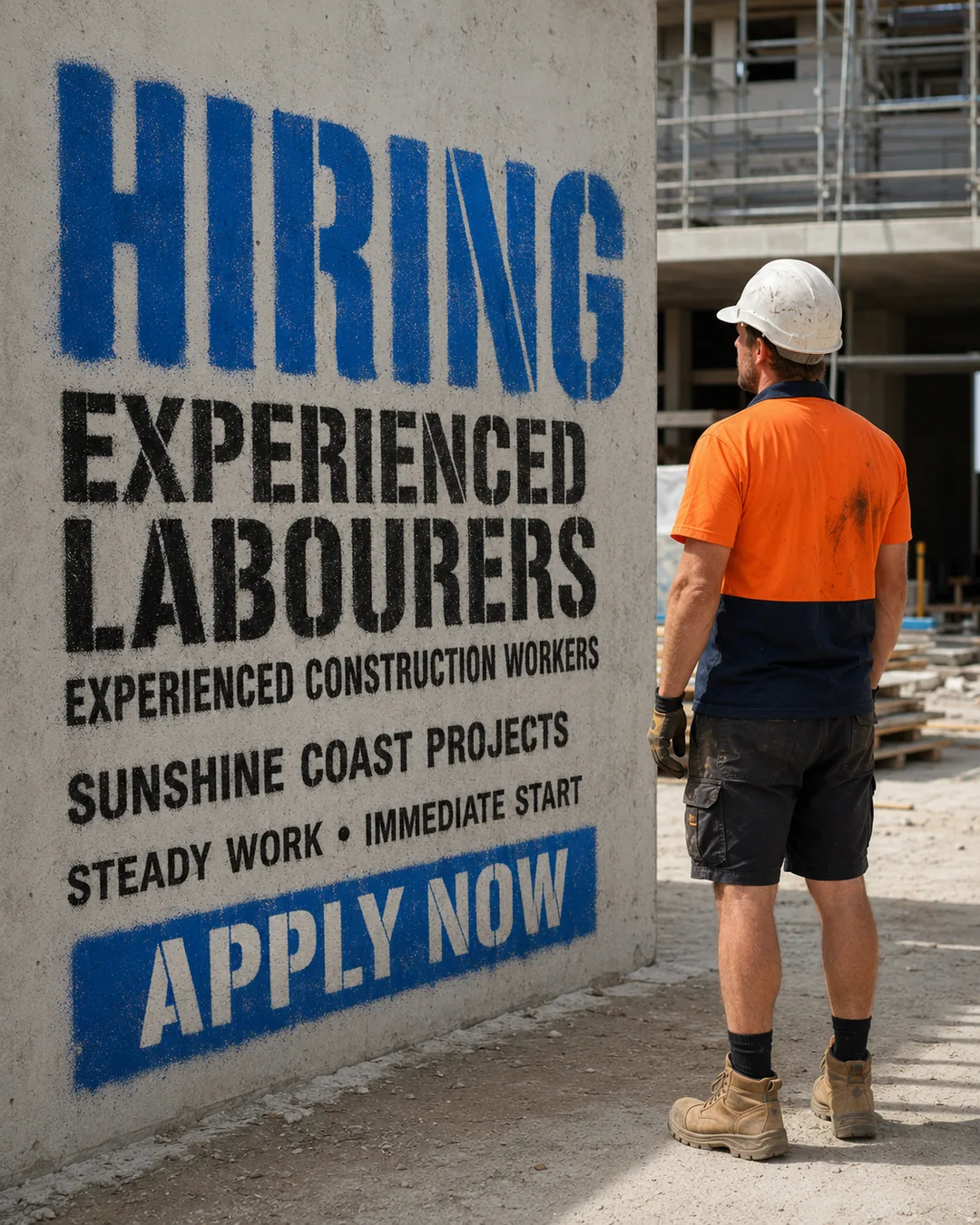
When applications slow down, the creative has usually tired. We swap in new images and angles before we touch the budget.
What are Meta's rules for job ads?
Meta treats job ads as a special ad category, Employment, to stop ads discriminating against who gets to see a job. It changes how you can target:
- No age or gender targeting. The age range is locked wide open.
- No lookalike audiences.
- No postcode or tight-radius targeting, so you target broader areas and the ad has to do more of the filtering.
The trap is that Meta scans ad images for hiring content and can apply the category itself, even if you didn't choose it. Running a job ad in an ordinary campaign is one of the common reasons ad accounts get restricted. Set the category up front.
With those levers gone, the work moves into the ad, the form and the screening. That's where Murphy's results came from.
What goes on the application form?
An instant form inside Facebook or Instagram, so nobody has to leave the app or write a CV. Keep it short, with screening questions that sort people before anyone picks up the phone. On Murphy's campaign the questions covered:
- which trade or role they're after;
- how long they've been doing it;
- when they could start;
- where they're based.
Every answer lands in a shared sheet the team can work from a phone, sorted by role. A supervisor can scan the list on site and ring the best ones that afternoon.
Every extra question costs you applicants, so only ask what you'd actually use to decide who to call.
What happens after someone applies?
This is where most hiring campaigns fall over. Tradies apply for a few things at once, and the builder who rings first usually gets them.
- Ring the best applicants the same day, while they still remember the ad.
- Send the rest a quick text so they know they've been seen.
- Keep the ones who weren't right this time. They're next month's shortlist when a new job starts.
How much should a builder spend on hiring ads?
It depends on the role and the region. Labourers are easier to reach than supervisors or leading hands, so they usually cost less per applicant. Start with a modest budget per role for a few days, look at who's applying, then put more behind the role that's bringing in the right people.
Work it backwards: how many people you need on site, and how many applicants it usually takes you to find one good one. That gives you a target number of applicants, and the first few days tell you what each one costs.
Questions builders ask about hiring ads
Can I target by age or gender in a Meta job ad?

No. Job ads run in Meta's Employment category, which removes age and gender targeting and lookalike audiences, and limits how tightly you can target a location. The ad and the form do the filtering instead.
Is a hiring campaign better than a job board?
It reaches different people. Job boards get people who are actively looking. Meta ads reach tradies who are working and not looking, which is where most of the good ones are. Plenty of builders run both.
Do you do the hiring for us?
No. We build and run the campaign and hand you sorted applicants. You interview and hire, because you know who'll fit your crew. We help you get the right people in front of you quickly.
Sources
Murphy Constructions: Meta form results and our cost-per-applicant workings for the July 2026 labourer batch; Ads Manager lifetime results for the hiring campaign to August 2026; hires as reported by the client, September 2026. Meta's Employment ad category: Meta's advertising policies, checked July 2026.
Jed Lynham, founder of Scaled Marketing. Published 24 Sep 2026. About Jed